Resisting The Thought Police- the Horror of Thought Crime
"[A] man . . .the other day pointed out that I was never bored. I hadn’t thought of that before, but it’s true: I’m never bored. I’m appalled, horrified, angered, but never bored. The world appears to me so infinite in its variety that many lifetimes could not exhaust its interest. So long as you can still be surprised, you have something to be thankful for." -Theodore Dalrymple
Delightful article in the latest number of The Spectator on forgotten English Easter traditions. You can find it here.
Well, not entirely forgotten or there would be no article. You may have to subscribe; not sure about that. Sometimes with these things you can get a few articles a month without a subscription. Give the link a click and see what happens. It's a good read. E.g.:
If you get up early enough on Easter morning, according to old English folklore, you might be lucky enough to see the sun dancing in the sky as it rises, rejoicing at the resurrection of Christ – although tradition also records that the devil usually manages to put a hill in front of the dancing sun to stop people seeing it.
. . . Hot Cross buns!
And for the first time in a very, very long time a local market's bakery has some. I bought some this very Good Friday afternoon. If you're local-ish and interested they were at Stater Brothers.
(So why do I wait for a market to carry them instead of baking myself? Well, it's like this. I produce a quite nice loaf of Irish soda bread. But my baking skills decrease rather precipitously after that. The market is really the best choice.
(The temptation to borrow a term from the old American Spectator of years ago and call this post The Intellectualoids was almost irresistible. But I managed.)
A paragraph from an article in this month's Chronicles entitled What's Wrong with the Intellectuals?
The social characteristics of the intellectual classes are alienation, aggressive secularism, progressive politics, and overweening self-confidence. Intellectuals are remarkably monolithic in their values and politics. They are also exceedingly socially uniform, notwithstanding their nearly unanimous embrace of the now-dominant rhetoric of diversity in American institutions.
In my only occasionally humble opinion, that paragraph from the article answers the question in a nutshell. But there is much more and worth the read.
. . . comes on a Tuesday this month. So I trust you avoided breaking any ladders or walking under any black cats. And remember, especially on an auspicious day like today: it's bad luck to be superstitious.
Never the less, it's been a pretty good day so far here at the ancestral manse. Imber abiit, et recessit, at least for the moment. More due over the weekend, so I'm told. But in the meantime the sun is shining, God is in His heaven, and I've even given a thought to The Inn. As you see.
If Hostis Herodes impie wasn't enough for the grand feast day, here's something from The Inn of a dozen years ago taken originally from the Blessed Cardinal Schuster's Liber Sacramentorum, giving a history of the day that's in it:
Epiphany means “appearance” or “manifestation,” and among the Eastern Christians had originally the same significance as Christmas in Rome. It was the festival of the eternal Word, clothed in the flesh, revealing himself to mankind. Three different phases of this historical manifestation were especially venerated – viz., the adoration of the Magi at Bethlehem, the changing of the water into wine at Cana, and the baptism of Jesus in the Jordan.
In the East special emphasis was laid on the scene at the Jordan, when the Holy Ghost overshadowed the Saviour in the form of a dove, and the eternal Father proclaimed him from heaven as his beloved Son. From the time of St John, the Gnostic heresy attributed great importance to this episode on account of its christology, maintaining that only then was the divine nature united to the human nature of Jesus, to leave it again at the moment of his Crucifixion. That baptism was, therefore, according to the Gnostics, the true divine birth of Jesus; consequently it was celebrated by them with the greatest splendour. It was against this doctrine that St John wrote in his first Epistle: Hic venit (Jesus Christ) per aquam et sanguinem, non in aqua solum, sed in aqua et sanguine; – that is to say, Jesus came into the world as the Saviour and as the Son of God, and this not merely in the waters of the Jordan, but from the very moment of his Incarnation, when he took upon himself our human body and blood.
In all probability the Catholics, following the example of the Evangelist, wished from the first to set against the Gnostic baptismal manifestation the temporal birth at Bethlehem; hence the feast had a very complex signification, inasmuch as it was desired to retain also the Gospel dates of the baptism and of the marriage at Cana, relegating them, however, to a secondary place as being similar solemn and authentic manifestations of the divine nature of Jesus. At Rome, in an atmosphere extremely practical and altogether foreign to the mystic etherealism of the Eastern world, the historical recurrence of the Nativity of our Lord came to occupy so prominent a place in the popular mind that it is still the predominating idea throughout the whole of the Christmas Liturgy.
There was, it is true, some uncertainty regarding its date, which led to a partition of the festival. On the banks of the Tiber the feast of January 6 was anticipated by two weeks, to the greater honour of the Nativity; but the ancient Theophania retained its place, although deprived of its full significance, since the crib of Bethlehem, by its power of attraction, gave greater prominence to the Adoration of the Magi, at the expense of the original idea of the baptism in the Jordan.
It is probable that in the third century Rome was still faithfully following the primitive Eastern tradition and administering solemn baptism on the day of the Theophania . Hippolytus, in fact, delivered an address to the neophytes (Είς τά αγία Θεοφάνεια) just as in the very ancient Coptic Calendar in which today's feast is called dies baptismi sanctificati. In the time of St Gregory Nazianzen the Greeks named it the Feast of the Holy Lights – In Sancta Lumina-- because baptism constitutes the supernatural illumination of the soul.
The third commemoration assigned to today's feast is of the first miracle performed by our Lord at the marriage at Cana. It is reckoned among the manifestation of Christ because the Gospel miracles supply the visible proof of the divine nature of Jesus. St Paulinus of Nola and St Maximus of Turin draw attention to the three-fold aspect of the feast of the Epiphany in terms exactly similar to those which the Roman Church employs in the grand antiphon of the Office at dawn. Hodia coelesti Sponso juncta est ecclesia-- mystical nuptials typified by those of Cana-- quoniam in Jordano lavit Christus ejus crimina-- baptism for the remission of sins--currunt cum muneribus magi ad regales nuptias-- the Adoration of the divine Infant-- et ex aqua facto vino laetantur convivae-- the miracle of Cana.
That which surprises us is that these primitive features of the Eastern Epiphany feast are found to have penetrated more or less in Rome into the festival of December 25 itself, so much so that Pope Liberius (325-366), in a sermon delivered at St Peter's on Christmas Day, on the occasion when Marcellina, sister of St Ambrose, received from his hands the virginal veil, said to her, among other things: “Thou, O daughter, hast desired an excellent marriage. Thou seest what a multitude of people is here assembled for the birthday of thy Spouse, and no one of them all goes away unsatisfied. He indeed it is who, being invited to the wedding feast, changed the water into wine, and who with five loaves and two fishes fed four thousand men in the desert.”
The station at St Peter's is inspired by the same thought as that of Christmas Day. In Rome the greater festivals – always excepting the very lengthy ceremonies of the Easter baptism – are celebrated at the Pastor Ecclesiæ whose basilica is the sheepfold of the Roman flock. The Ordines Romani prescribed down to the thirteenth century that after Mass the Pope should put on his tiara and return on horse-back to the Lateran. Later on, however, the Pontiffs preferred to remain at the Vatican for the second Vespers also, at which they were present in a scarlet cope and wearing a golden mitre. The custom of the Pope himself celebrating the stational Mass on this day is witnessed to, down to the end of the fourteenth century, in the Ordo of Bishop Pietro Amelio of Sinigaglia, in which the sole exception to the rule is in the case of the Pontiff being prevented from officiating either by some malady or by the rigour of winter weather.
O God, who by the leading of a star didst manifest Thy only-begotten Son to the Gentiles ; mercifully grant ; that we, which know Thee now by faith, may after this life have the fruition of Thy glorious Godhead. Through the same our Lord Jesus Christ. Amen.
Why, impious Herod, vainly fear
That Christ the Saviour cometh here?
He takes not earthly realms away,
Who gives the crown that lasts for aye.
To greet His birth the Magi went,
Led by the star before them sent:
Call'd on by light, to Light they press'd,
And by their gifts their God confess'd.
In holy Jordan's purest wave,
The heav'nly Lamb vouchsaf'd to lave;
That He, to whom was sin unknown,
Might cleanse His people from their own.
New miracle of power divine!
The water reddens into wine:
He spake the word, and pour'd the wave
In other streams than nature gave.
All glory, Lord, to Thee we pay,
For Thine Epiphany today;
All glory, as is ever meet,
To Father and to Paraclete. Amen.
I love the old Evensong/Vespers hymn for Epiphany: Why impious Herod, vainly fear that Christ the Saviour cometh here? Lovely. And before you ask, yes, I have failed to post anything for all the Christmastide feasts until now the almost very end. Health, don't you know. Or more accurately, lack of same. I move a lot slower these days and Mary depends on me more. And so with one thing and another, there don't seem to be as many hours in the day as once there were.
What's that? I forgot bone-laziness? Well, that's pretty rude of you. But I suppose, in all honesty, there's still a touch of that in play. Fallen human nature abides . . . .
When in the market, for no apparent reason, you buy far more kleenex than you would normally need.
And believe me, as it happened, I've really needed them.
By code isn't quite over just yet but I am a bit better now, thank you.
Sniff.
. . . which, I suppose, The Inn might be if anyone other than I ever read it. I mean, hardly "mass" culture when it's so local as to show up nowhere other than this very pc. And now that I think about it, "culture" may be assuming facts not in evidence.
In any event, I've been attempting a clear-out of the files shelves desk entire office. It is now clear that all those things I have been meaning to read later, maybe tomorrow . . . . well, it isn't going to happen. I won't live long enough. No terminal illness. It's just that, as the psalmist says, the days of our age are threescore years and ten; and though men be so strong that they come to fourscore years, * yet is their strength then but labour and sorrow; so soon passeth it away, and we are gone. And in the meantime the office is assuming hazardous proportions. The fire department would not approve.
So I've been reading rather more than is helpful in clearing-out. Well, you do, don't you. The March/April 2023 number of Touchstone, for instance. So much good stuff. F'rinstance:
I recall Gene Roddenberry stating, "Television exists for just one reason -- to sell you things." Mass consumer culture is more than a vendor. The range of its dynamics is greater than simply facilitating the transfer of wealth from consumer to merchant. Mass culture is a principal venue for propaganda, seduction, illusion, and additions.
That, from Robert McTeigue's essay Resistance Writer. And an even more powerful paragraph in the context of the essay than that excerpt shows. And it's that sort of thing that makes clearing-out in the office so much more time consuming than clearing-out, say cans of soup past their sell-by date in the kitchen.
Back to work.
After thought: Clear-out and clearing-out: should they be hyphenated? I can't make up my mind. I put them in and they look right. But I can't find a rule on line and I don't know what I've done with my Fowler's.
From the Commonitorium of St Vincent of Lerins:
What then will the Catholic Christian do, if a small part of the Church has cut itself off from the communion of the universal Faith? The answer is sure. He will prefer the healthiness of the whole body to the morbid and corrupt limb. But what if some novel contagion tries to infect the whole Church, and not merely a tiny part of it? Then he will take care to cleave to antiquity, which cannot now be led astray by any deceit of novelty. What if in antiquity itself two or three men, or it may be a city, or even a whole province be detected in error? Then he will take the greatest care to prefer the decrees of the ancient General Councils, if there are such, to the irresponsible ignorance of a few men. But what if some error arises regarding which nothing of this sort is to be found? Then he must do his best to compare the opinions of the Fathers and inquire their meaning, provided always that, though they belonged to diverse times and places, they yet continued in the faith and communion of the one Catholic Church; and let them be teachers approved and outstanding. And whatever he shall find to have been held, approved and taught, not by one or two only but by all equally and with one consent, openly, frequently, and persistently, let him take this as to be held by him without the slightest hesitation.
Unconscionably pilfered - including the highlighting - from this morning's post on Fr Z's excellent blog which you can find here.
I very much liked the collect for St Luke in the Ordinariate Office today. In case you've misplaced your Daily Office book, here it is:
ALMIGHTY God, who didst call Saint Luke, whose praise is in the Gospel, to be an Evangelist and physician of the soul: may it please thee; that, by the wholesome medicines of the doctrine delivered by him, all the diseases of our souls may be healed; through the merits of Jesus Christ thy Son our Lord, who liveth and reigneth with thee, in the unity of the Holy Spirit, ever one God, world without end. Amen.
One of the least profitable conferences hosted in Las Vegas was the 1986 gathering of the American Physical Society---hardly anyone gambled, presumably, because the physicists understood probability and statistics, and saw no benefit in gambling.
I don't gamble myself. Nothing to do with statistics or probability. It's not even virtue. I'm just a really poor loser.
. . . . time's winged chariot hurrying near.
Yesterday was the forty-third -- that's 43d -- anniversary of our wedding day. We didn't do much. Just pottered about, as is our wont. Oh, and had a lovely meal from Baja Sonora. The restaurant doesn't look like much from the outside. But you'll be hard pressed to find a tastier Mexican dinner hereabouts.
We share some -- most? -- of the aches and pains that older flesh is heir to. But one thing still puzzles me. I got old all over. But Mary just got the aches and pains; she still has the face of a young woman. 30 maybe? I have no idea how she does that. If I ever find out, I'll let you know.
This is the latest in an ongoing series of conversations on topics of Catholic interest. Well, of great interest to me: "Questions of Authority: - Interpreting the crisis. Altman-Strickland-Muller" so sayeth the youtube subtitle. I've been meaning to cite Catholic Unscripted here for some time but as you have probably notice I haven't cited this or anything else for a while. This week's presentation finally got me off the dime and cranking up The Inn for a post.
“Nothing travels faster than the speed of light,with the possible exception of bad news,which obeys its own special laws.”― Douglas Adams, Mostly Harmless

O LORD our God, whose Name only is excellent and thy praise above heaven and earth: we thank thee for all those who counted not their lives dear unto themselves but laid them down for their friends; grant us, we beseech thee, that having them always in remembrance we may imitate their faithfulness and sacrifice; through Jesus Christ thy Son our Lord, who liveth and reigneth with thee, in the unity of the Holy Ghost, ever one God, world without end. Amen.
Almighty God, our heavenly Father, in whose hands are the living and the dead: We give Thee thanks for all those Thy servants who have laid down their lives in the service of our country. Grant to them Thy mercy and the light of Thy presence, that the good work which Thou hast begun in them may be perfected; through Jesus Christ Thy Son our Lord. Amen.
[The parents of King Charles II] Charles I and Henrietta Maria (daughter of Henry IV of France), who had been married in 1626, had a child named Charles James born to them in March 1629, but who did not live above a day. Their second infant, who was destined to live and to reign, saw the light on the 29th of May 1630, his birth being distinguished by the appearance, it was said, of a star at midday.
"It was on his thirtieth birthday, the 29th of May 1660, that the distresses and vicissitudes of his early life were closed by his triumphal entry as king into London. His restoration might properly be dated from the 8th of May, when he was proclaimed as sovereign of the three kingdoms in London: but the day of his entry into the metropolis, being also his birthday, was adopted as the date of that happy event. Never had England known a day of greater happiness. Defend the Commonwealth who may—make a hero of Protector Oliver with highest eloquence and deftest literary art—the intoxicated delight of the people in getting quit of them, and all connected with them, is their sufficient condemnation. The truth is, it had all along been a government of great difficulty, and a government of difficulty must needs be tyrannical. The old monarchy, ill-conducted as it had been under Charles I, shone white by comparison. It was happiness overmuch for the nation to get back under it, with or without guarantees for its better behaviour in future. An army lately in rebellion joyfully marshalled the king along from Dover to London.
Why Oak Apple Day? It's in honor of the oak tree in which the king took refuge from the marauding parliamentary forces. The full, rather romantic story can be found at the link above.
If you've a mind to sing along to the tune at the top the lyrics can be found in full here.
A sample:
Why should we speak of Caesar’s acts,
or Shimei’s treacheries,
Or of the grand notorious facts
of Cromwell’s tyrannies?
But what we all might gladly sing,
and bravely chant and say,
That Charles the second did come in
the twenty ninth of May.Since that his royal person went
from us beyond the seas,
Much blood and treasure have been spent
but ne'er obtainéd peace:
Until the Lord with-held his hand
as we might cheerful say,
And did a healing balsam send
the twenty-ninth of May!. . .Now let all people celebrate
this day which is so pure,
And to be kept by church and state
for ever to endure.
That generations all might see
the honour of the day,
Which everlasting it shall be
the twenty-ninth of May!So God preserve our gracious king
the Duke of York also,
Defend them from the dragon’s sting
and every Christian foe.
Then let true loyal subjects sing
and bravely chant and say,
The like in England ne’er came in
the twenty ninth of May.
And if the tune, though played pretty sprightly here, seems familiar, you might have sung it to a slightly different tempo as "All Things Bright and Beautiful". And for what it's worth, with the tempo cranked up a bit it makes a pretty fair jig, too.
Labels: Regem honorificate!

Grant, we beseech Thee, Almighty God: that like as we do believe Thy Only Begotten Son our Lord Jesus Christ to have ascended into the heavens; so we may also in heart and mind thither ascend, and with Him continually dwell, Who liveth and reigneth with Thee, in the unity of the Holy Ghost, ever one God, world without end. Amen.

Plebs tibi, Domine, Virginique Matri dicata, beati Simonis, quem ei Rectorem et Patrem dedisti, solemnitate laetetur : et sicut per eum tantae protectionis signum obtinuit ; ita praedestinationis aeternae numera consequatur. Per Dominum. Amen.
Today is the feast in the Carmelite calendar of St Simon Stock, to whom Our Lady gave the Carmelite scapular with its wonderful promises. We've mentioned him on The Inn before. And since I don't mind repeating myself you can find as couple of those mentions here and here.
. . . . He Whom thou wast meet to bear, Alleluia!
As he promised, hath arisen! Alleluia!
Pour for us to God thy prayer! Alleluia!
Those "Baby on Board" signs seem to be back in vogue They were quite the thing back in the '80s. Have you seen them? They're little diamond shaped stickers that mimic yellow highway signs and grace automobile rear windows and they say just that: "Baby on Board".
I can't think what they're for. Do the owners imagine that without the little stickers they're going to be rammed and run off the road into a ditch? Are the sort of people who would do that sort of thing really going to be deterred by a Baby on Board sticker? And what about the people who have the sticker but have apparently forgotten the baby, of which there seem to be more than a few. Is that false advertising of a sort? All very puzzling.
Unless, of course, the sticker-bearers are merely announcing to the world that they have brought a child into the world and are proud of it. In which case, congratulations and God bless.
I've noticed in the markets lately the checkers no longer ask me if I've found everything. I suspect that's because they know well I haven't. All sorts of things are out of stock and no one knows when or if they'll ever by back. It may not all be the fault of the Biden maladministration. But it isn't helping.
And then there are shirt manufacturers. Dear shirt-makers: please give a thought to sizing. Just because my waist has expanded it does not therefore follow that my arms got any longer. S, M, L, XL, and XXL may signify some rational standard in your dream world but out here in reality land . . . not so much. Oh, for the days when one could choose by sleeve-length, neck size, and waist size.
When I was a barefoot boy and a beardless youth there were certain political/cultural verities that went without saying. The conservative worshipped at the altar of big business and the liberal made novenas to big government. And now it seems the right finds that big business needs some reining in and many on the left are no longer entirely sure that big government is our friend. So, will anything change? Of course (the post immediately below this one to the contrary notwithstanding). In what way? In the immortal word of the late S.W., Damfino.
Onward, ever onward.
Tocqueville on the the extraordinary uniformity of opinion he encountered in America. He wrote in Democracy in America (published 1838):
In the United States, the majority takes charge of providing individuals with a host of ready-made opinions, and thus relieves them of the obligation to form for themselves opinions that are their own. I know of no other country where, in general, there reigns less independence of mind and true freedom of discussion than in America.
Vide: practically any American university if you need proof that nothing has changed.
(Have I been having a pleasant read through my copy of Tocqueville this lovely Sunday afternoon? Much as I'd like to have you think so, the above is actually from a review of a recent biography of Tocqueville in the latest Spectator. You can find it here.)

Antiphon: O Virgin Mother of God, whence the Light Eternal deigned to dawn upon us, regard we pray thee, the pleading of thy humble servants, that by thy holy intercessions we may merit to obtain the mansions eternal.
Introit: Drop down , ye heavens, from above, and let the skies pour down righteousness: let the earth open, and bring forth a Saviour.
Collect: O God, Who didst decree that, at the angel's message, Thy Word should take flesh in the womb of the Blessed Virgin Mary, grant to us Thy suppliants that we who believe her to be indeed the Mother of God may be helped by her intercession with Thee: through the same Jesus Christ our Lord who liveth and reigneth with Thee in the unity of the Holy Ghost, ever one God, for ever and ever. Amen.
At one time today would have been New Year's Day: the first day of Our Lord's human life on earth, the beginning of our salvation, even the beginning of spring. Makes sense to me. Apparently not, though to whomever it is decides these things for us.
I consulted Kevin Danaher's wonderful The Year in Ireland: Irish Calendar Customs expecting to hand on many "Lady Day" gems of custom and tradition. But no. This was it, in toto:
25 March, the feast of the Annunciation, was a Holiday (sic) of Obligation on which the Lenten fast was relaxed although there was in Ireland no extensive merry-making as on St Patrick's Day. It had some legal significance for, until Britain belatedly accepted Pope Gregory's calendar in 1752, the year began officially on 25 March, which was thus of importance as regards contracts, leases, rents and so on.
Apart, however, from its religious and legal significance, it had little effect on popular tradition. High winds were expected on this day, and if it coincided with Easter Sunday people feared that the following harvest would be poor, with consequent scarcity of food.
Disappointing, wasn't it. I expected more of our ancestors. Maybe they were worn out from the fasting and abstaining one had to do in those days.
Finally, something from the late and greatly missed -- her column alone was worth the cost of an overseas subscription to The Spectator -- Alice Thomas Ellis:
[She] once took part in an earnest feminist questionnaire that asked her to name the most important event in women's history. "The Annunciation" she replied.
It was six years ago today -- 18 March -- that our beloved Fr Daniel Johnson died. Fr Hugh, who spoke at Fr Johnson's funeral Mass, gave this lovely image: Father Johnson died on the 18th of March. St Patrick, whose feast was Father Johnson's last full day on earth, took his left hand, and St Joseph, whose feast was Father's first full day in eternity, took his right hand and they led him to the judgement seat of the Merciful Judge.
Linked below are a few of the things I was thinking at the time. Some of my grumpy whinges are no longer . . . hmm, what shall I say? "Valid" isn't quite the word. They certainly still apply to the circumstances of the time. Up-to-date, is I suppose, more appropriate. For a start, circumstances have changed. There is a new bishop of the Diocese of Orange. And the authentic rite of the Roman Mass is back at St Mary's.
In any event, herewith the said links:
The Last Usus Authenticus Mass at St Mary's (but only for a while, as it turned out).
A Miracle? Maybe, maybe not. Nice co-incidence, though. And Custodes Traditionis, or whatever it's called, to the contrary notwithstanding, the Old Mass continues at St Mary's.
I would actually get no thanks from Fr Johnson for that last linked post. He wanted prayers for his soul, not do-it-yourself canonisations. So I shall comply with his wishes now. You can too, if you've got a minute or two.

A collect for the day that's in it:
O ALMIGHTY God, who in thy providence didst choose thy servant Patrick to be an apostle to the people of Ireland, to bring those who were wandering in darkness and error to the true light and knowledge of thee: grant us, by his intercession, so to walk in that light; that we may come at last to the light of everlasting life; through Jesus Christ thy Son our Lord, who liveth and reigneth with thee, in the unity of the Holy Spirit, ever one God, world without end. Amen
.
I'll be off shortly to play some pipes with the Sheriff's band and serenade assorted revelers. I expect it to be good fun. Nevertheless, a short prayer that your aged and decrepit servant can hold up his end of the tunes until the final set would not go amiss.
(As always, clicking on the image above will make it larger -- occasionally too large -- so you can read the inscription.)
Boy, howdy, did it ever. All sorts of things went cleverly wrong that day. It was topped off by being an hour late to band practice due to the county fiddling around with the road I take and turning three lanes into one for several miles. Several miles, I may add, during which, traveling through the Naval base as we do, there is no place to even turn off and try for a different route.
Things in general have not been chugging along quite as smoothly the rest of this week as we might have hoped. But you're not interested in that. Still, we have been carrying on as best we can in our advanced state of decrepitude. Not much of a post, I agree. But than it hasn't been much of a week.
And you're right: "cleverly" isn't quite right. And not really the word I was looking for in any case. But Roget's hasn't helped find that perfect word hiding out in the back of my mind. So, I've just left "cleverly" in place. At first glance it does look like it might mean something deep. At first glance.
Oh, yes, and even though it's no longer Friday-the-13th-on-Monday, it's still good advice: don't break any ladders or walk under any black cats and don't be superstitious. It's bad luck to be superstitious.
Something from a letter I received today. A few sentences from Pope Benedict XVI's second encyclical;
.“Hope is practiced through the virtue of patience, which continues to do good even in the face of apparent failure, and through the virtue of humility, which accepts God's mystery and trusts Him even at times of darkness. Faith . . . gives us the victorious certainty that it is really true: God is love! It thus transforms our impatience and our doubts into the sure hope that God holds the world in His hands, and that, as the dramatic imagery of the end of the Book of Revelation points out, in spite of all darkness He ultimately triumphs in glory.”
That very much spoke to the heart this cloudy afternoon.
And not only on time for Candlemas Day, but three days early for Septugesima Sunday which isn't for another three days.
I'm so proud of myself
.

How long is Christmas?When you go into a church on the first day of February and see a crib still there long after we have all got rid of our trees, the question presents itself in concrete form.Christmas is Christmas Day – of course.Christmas is the Twelve Days of Christmas, from the birth of Jesus and his appearing to the shepherds up to the Epiphany, the coming of the Wise Men and the first appearance of the incarnate God to the Gentiles.Christmas is more than that. The celebration of the Incarnation is not complete until Jesus is sent out on his mission on the feast of the Baptism of the Lord.Christmas and the Epiphany and the Baptism are three facets of the same event, and it resonates throughout the liturgy of the period. But there is more to come.Before Christmas there is a seven-day countdown, marked by the ancient ‘O Antiphons’ – and that is part of the bigger almost-four-week warm-up which starts on Advent Sunday. Cribs often start then. I remember seeing one in Hildesheim in Germany which was 20 feet long and told the whole story of salvation history, beginning with a Garden of Eden with giraffes in it.After the triple Christmas-Epiphany-Baptism celebration, it still isn’t all over. The afterglow of Christmas still carries on. The Marian anthem at Compline is the Alma redemptoris mater, and the Crib is still to be seen in churches. This is because Jewish tradition does not bring the season of “a child has been born” to a close until forty days have passed. Forty days bring us to today, so today is final, definitive closure of the Christmas season as a whole: the feast of the Presentation in the Temple, with all its candles.And that is that. Now we are back to normal. Or rather, we aren’t, because nothing is normal. The entire ten-week celebration has taken us once again through the transition from BC to AD, and it reminds us that we are in a ‘new normal’ which is not normal at all, because the Child has been born.God is with us, and can never not be.
And that's why the Christmas tree stayed up until Candlemas Eve.
The February number of Opera News came today. (What? You thought I was limited to The American Conservative, The Remnant and talk radio? I'm disappointed in you. The Metropolitan Opera Saturday matinees have been on the radio since, I think, the '40s and on my radio since I was in high school. . . which was, indeed, a very, very long time ago but, ahem, later than the '40s.)
Where was I? Oh, yes, the Opera News. The February number came today and there on page 10 was this delightful bit about the late Chief Justice Rehnquist:
Ruth Bader Ginsburg and Antonin Scalia were famous opera fans, but William Rehnquist had his tastes, too. In 1995, the chief justice added four gold stripes to his robes, which he infamously wore at Bill Clinton's impeachment trial.. "he [was] lampooned by Jay Leno, derided by cartoonists and ridiculed across continents" for them, the Washington Post reported. He'd added them as "a whimsical emulation of the Lord Chancellor" in Gilbert and Sullivan's Iolanthe. USA Today explains. "Asked years later to assess his role during the impeachment trial . . . Rehnquist quoted from that opera: 'I did nothing in particular, and I did it very well.'"
This is a first: I've never used the blogger app on my phone before. Seems to be working. . . but there is still the one-finger-typing issue. Hate that.
. . . and He has been. And is doing so again today. "Thou, O God, sentest a gracious rain upon thine in heritance, and refreshedst it when it was weary." -Psalm 68, ix
There is supposed to be a video showing the rain off our front porch right about
"here"
for your information and delectation. But for reasons known only to the Blogspot software, it only shows up on the input page and not on the actual blog. Not much of a loss to posterity but still annoying to me.
In any event, we are fortunately at the tail end of the various storms that have come through the west coast and haven't had the flooding and isolation that other areas have had. Just a lovely rainy day here, good for large pots of tea and biscuits.*
___________________________
*"biscuits" = "cookies" in this house. Mary is occasionally annoyed when someone tells her that she's losing her accent. I usually point out that it isn't lost. I have it. Which isn't, strictly speaking, true. What I have is not so much the accent as the turns of phrase that were common in the Ireland of her youth. Which is why biscuits and cookies are used interchangeably hereabouts.

Our chapel this morning, taken after the last Mass. I'm not entirely comfortable taking pictures during Mass. Lèse majesté may be a bit strong. Perhaps just not sufficiently reverent?
Any way, very happy to be back home at St John's this Sunday.
That 2d picture is not our church but it was our recessional this morning. I love that hymn.
1. As with gladness men of old
Did the guiding star behold,
As with joy they hailed its light,
Leading onward, beaming bright;
So, most gracious Lord, may we
Evermore be led to Thee.
2. As with joyful steps they sped
To that lowly manger bed,
There to bend the knee before
Him whom heaven and earth adore;
So may we, with willing feet,
Ever seek the mercy seat.
3. As they offered gifts most rare
At that manger rude and bare;
So may we with holy joy,
Pure and free from sin’s alloy,
All our costliest treasures bring,
Christ! to Thee, our heavenly King.
4. Holy Jesus! every day
Keep us in the narrow way;
And, when earthly things are past,
Bring our ransomed souls at last
Where they need no star to guide,
Where no clouds Thy glory hide.
5. In the heavenly country bright,
Need they no created light;
Thou its light, its joy, its crown,
Thou its sun which goes not down:
There for ever may we sing
Alleluias to our King. Amen.

O GOD, for whose Church the glorious Bishop Thomas Becket fell by the swords of wicked men: grant, we beseech thee; that all who call upon him for succour may be profited by the obtaining of all that they desire; through Jesus Christ thy Son our Lord, who liveth and reigneth with thee, in the unity of the Holy Spirit, ever one God, world without end. Amen.
Fr Z this morning has a very interesting post about the finding of the prayer book -- psalter, actually -- that St Thomas was holding when he was murdered. You can find it here. Clicke, lege as we used to say in the early days of Catholic blogdom. It's a fascinating read.
Salva nos, Domine! Perimus!

O Mary, God's own Mother,
Pray for our native land;
And ye, O Saints and Angels,
Around the throne who stand;
Pray for our darkened country,
That faith may live again,
That Jesus in His Sacrament
At last supreme may reign!
EASTERTIDE

"Christ is Risen! Indeed He is risen and has appeared to Simon."
SAINTS OF APRIL


September 24
FEAST OF OUR LADY OF WALSINGHAM
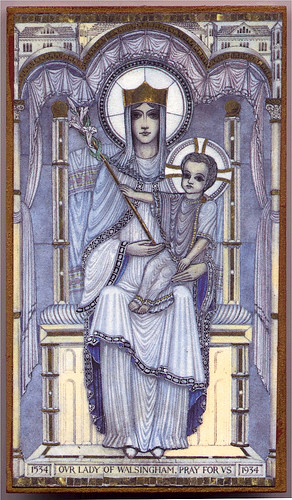
Patroness of the Ordinariate of the
Chair of St Peter
O God, Who, through the mystery of the Word made flesh, didst in Thy mercy sanctify the house of the Blessed Virgin Mary: do Thou grant that we may keep aloof from the tabernacle of sinners, and become worthy indwellers of Thy house; through Jesus Christ Thy Son our Lord, Who liveth and reigneth with Thee, in the unity of the Holy Ghost, ever one God, world without end. Amen.
++++++++++++++++++++++++++
Health Advisory
In the event of an inadvertent overdose of Vatican news, click here and follow directions.
[“On the barque of Peter, those with queasy stomachs should keep clear of the engine room.”
-Msgr Ronald Knox]
++++++++++++++++++++++++++

St Thomas Becket, Archbishop & Martyr
Ant. This Saint hath striven for the law of God even unto death,
and hath not feared for the swords of the ungodly; for he hath been
founded upon a firm Rock.
++++++++++++++++++++++++++
The men of the East may spell the stars,
And times and triumphs mark,
But the men signed of the cross of Christ
Go gaily in the dark.
The men of the East may search the scrolls,
For sure fates and fame,
But the men that drink the blood of God
Go singing to their shame.
+ + + + + + +
But you and all the kind of Christ
Are ignorant and brave,
And you shall have wars you hardly win
And souls you hardly save.
I tell you naught for your comfort
Yea, naught for your desire,
Save that the sky grows darker yet
And the sea rises higher.
Night shall be thrice night over you,
And heaven an iron cope.
Do you have joy without a cause,
Yea, faith without a hope?
from The Ballad of the White Horse
-G. K. Chesterton

The Anglican Ordinariates in the Catholic Church

CARMEL


Sailing to Byzantium







"Two of the pubs near Oxford which C.S. Lewis frequented were The Trout and The Six Bells.
Some of Lewis's American readers had written him to inquire about his views on drinking
alcoholic beverages. His response to them was in no uncertain terms: 'I have always
in my books been concerned simply to put forward mere Christianity, and am no
guide on these (most regrettable) interdenominational questions. I do however
most strongly object to the tyrannic and unscriptural insolence of anything that calls
itself a Church and makes teetotalism a condition of membership. Apart from the more
serious objection (that Our Lord Himself turned water into wine and made wine the medium
of the only rite He imposed on all His followers), it is so provincial (what I believe
you people call small town). Don't they realize that Christianity arose in the
Mediterranean world where, then as now, wine was as much a part of the normal diet as bread?"
C. S. Lewis: Images of His World by Douglas Gilbert & Clyde S. Kilby
